by Christie Purifoy | Jul 29, 2011 | Food, Religion

I stopped eating sugar three months ago. Well, to be perfectly honest, I still treat myself a bit on the weekends. And birthdays. I’ll never pass up birthday cake. But Monday through Friday, and even most of the time Saturday and Sunday, I sweeten my oatmeal with banana, I omit even the agave syrup from my smoothies, and I say no to every dessert, piece of candy, and slice of gum.
I’ve known for years that sugar wreaks havoc on my body. First, it was just my hormones. A direct link between dessert and my inability to get pregnant.
Highly motivated, I changed my diet. I had three miracle babies.
Then I went back to the cookies and ice cream.
I moved to Florida. I found a new doctor. He ordered a battery of tests. The news wasn’t good.
I don’t want to die of a heart attack or a stroke before I see my babies have babies. Once again, I am highly motivated.
I’ve had a fierce sweet tooth for as long as I can remember. If you had asked me when I was a child what my favorite food was, I promise you I would have said Cadbury Cream Eggs. Potato chips and popcorn, I can take or leave (though, of course, I take them frequently!). Chocolate chip cookies in the freezer will haunt me until every single one is gone.
When I first traded ice cream for mint tea after dinner, I felt sorry for myself. It seemed unfair. I imagined that everyone else could eat chocolate as often as they liked without fear of diabetes or heart disease.
My husband and children pour on the maple syrup while I frown and grumble over sprouted grain toast with none of my favorite blueberry jam.
But now . . . I’ve had an epiphany. I’ve realized something I might have noticed sooner if I hadn’t been preoccupied with feeling sorry for myself.
It was last Friday night. The week had been long, I was tired, and I decided to start the weekend off with a special treat. I would make chocolate chip cookies. And not just any chocolate chip cookies. The very best. The cookies from a cookbook called The Best Recipe. A cookbook that more than delivers on its title.
It was nearly nine o’clock when I sat down to taste those cookies, so sure that I was about to taste the goodness I’d denied myself all week.
After the first bite, I thought there was a mistake. I pictured my hand dumping in the cupful of brown sugar and wondered if I had miscounted.
My husband sat beside me at the table, and I asked, “Do these taste funny to you?” His look said, “What are you talking about?” and so I understood that the cookies only tasted strange to me. They were so, so sweet.
Unbearably sweet. I felt as if I were eating pure sugar, could almost feel the grains of it crunching sickeningly between my teeth.
This sweetness was no longer sweet. It was awful. One dimensional. Flavorless.
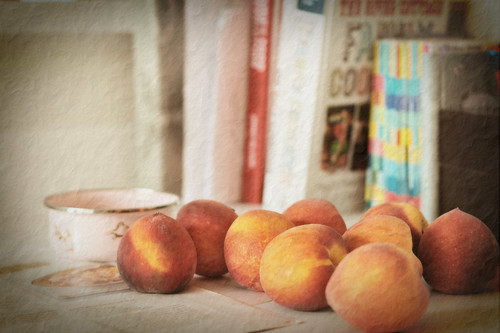
Here is the sweetness I’ve enjoyed all these months: the syrupy sweetness of a ripe peach, the crisp, tingly sweetness of ice-cold watermelon, the tart-sweet of blackberries, and the mellow, warm sweetness of a candy-colored sweet potato.
God has given me so many kinds of sweet: a whole spectrum of flavor and texture and color.
I never knew. Never truly tasted what was always right in front of me.
How often do we do this? Drag our feet and feel sorry for ourselves when all our father-God wants is to give us something good? Something better than the one-note flavor of whatever substitute we’ve provided for ourselves?
This thing I’ve been calling loss? Turns out, it was no loss at all.
by Christie Purifoy | Jul 19, 2011 | allergies, Family, Food
We’ve kept an extra place at our kitchen table for years, and lately I’ve been trying to figure out the whys and hows of the uninvited guest who frequently sits there.
I never notice him right away. Usually, we’re a few minutes into our meal when I first realize that he’s joined us. I see my son’s eyes grow a little bigger and a little rounder. Next, he says something like, “Is this my special pizza?” Or, maybe, “I think this hot dog is making my throat hurt.”
The name of our guest? Fear.
Sometimes, he’s just a shadow flitting around at the edges of our conversation. “Don’t worry,” I say. “You probably scratched your throat with that tortilla chip. You’re fine.”
Other times, he monopolizes the meal, entirely. My heart starts racing. Unsure of what’s happening, I mentally thumb through each of the possibilities. Did baby brother touch his food? Did I doublecheck that label? The package looked a little different. Did they change the formula?
I whisper to my husband, “Get the Benadryl. Let’s get it ready, just in case.”
My son sits staring into space, and I can tell that he’s making an effort to swallow. I know that he’s afraid and trying to figure out what’s happening in his throat. I keep up a conversation hoping that if I look unafraid my boy will be able to relax.
Then I notice that the hand holding my fork is shaking.
The thing about this particular fear is that it always takes me to the same place. Utter dependence. I pray without using any words. And I remember: this boy is loved. He is, and always will be, safe in his Father’s arms. All will be well. No matter what.
Only then do I start to breathe easily again.
I walk away from the table, stooped a little with fear, limping like Jacob.
The fear, like a hip out of joint, is not an entirely bad thing. I can’t feel it without remembering that I too wrestled with God. When failed fertility treatments and another month of bad news said, “Despair,” God gave me faith to grab the hem of His son’s robe, to pray and pray without letting go and to be healed. This boy, this good gift, was on the way.
Will I ever send my son to school without worrying that a stray spill on the cafeteria table might cause death to flare up in his throat?
We pray for healing. We pray for miracles.
Lately, the miracle I’ve been dreaming of looks a little different than the one I used to imagine. It isn’t a dream that my son grows out of his allergy (something that would be miraculous given the severity of his reactions). It isn’t a dream of supernatural, spontaneous healing, although I believe deeply that such things do happen. I may be a rational academic by training, but, like Shakespeare’s Hamlet, I know that “there are more things in heaven and earth, Horatio, than are dreamt of in your philosophy.”
The miracle looks more like this: a team of scientists and doctors at Mt. Sinai discovering that some children, fed a steady diet of baked milk proteins in carefully calibrated amounts, can increase their tolerance. They may never sit and drink a glass of milk, but they can eat a slice of cheese pizza at a class party without risk of anaphylaxis.
Miraculous.
Suddenly, a healing touch straight from heaven seems . . . a little boring. A little limited. What seems truly miraculous is the divine at work in a doctor’s lab. The divine bringing hope to more than just one child. Miracles baked into muffins.
by Christie Purifoy | Jun 21, 2011 | Family, Food
I had a different post planned for today. I was going to write something cute and sweet about the parent/child date nights we have planned for our summer. Monday was the first: a date for me and my oldest boy. It started well and ended horribly. Actually, I suppose it ended well, but the middle was truly bad.
I can’t write it out in detail (it’s too recent and too raw), but the condensed version is this: a quick and terrible allergic reaction, a mother who forgot to bring the epi-pen, a stranger standing next to us who hands me her own child’s pediatric epi-pen, an ambulance and a crowd of paramedics. The epi-pen did its job immediately and thoroughly, and the boy who couldn’t swallow or talk to me ended the night playing a wild game of cops and robbers all throughout the house.
This morning I used a stain-remover stick to dab a pair of size-4T shorts. The shorts are marked with chocolate sorbet (it was labeled dairy-free) and blood (those epi-needles are serious things). I don’t know if the stains will come out. I’m not sure that I care, but I do wish I had a stain-remover stick for my memory. At breakfast, my boy said, “Last night was scary.” Then I wished I had a stain-remover stick for his memory too.
A year ago, just before we left Chicago, two dear friends prayed for me and for my boy. It was the first time that I actually believed that my son might be healed. I also felt healed, no longer so afraid. For one year I have continued to monitor my son’s food, continued to carry his Benadryl and his epi-pens, but I stopped carrying the fear.
Last night, as I tried to fall asleep, I kept hearing this question: “Are you afraid?” I thought about it. This year I haven’t been afraid because I believed that my son was healed. I believed that food couldn’t hurt him anymore. Now I know that his allergies are worse. Now I see (again) that I am incapable of taking perfect care of him. Am I afraid?
I am tired, and I am sad, but I do not think that I am afraid.
I know that my son was made by a God who loves him even more than I do. And I know: “Because of the Lord’s great love we are not consumed” (Lamentations 3:22).
In this life, there will always be something to fear. I cannot work hard enough or be vigilant enough to erase every cause for fear.
The only antidote is love. I know that nothing can happen to me or to my child that is not filtered through Love. Nothing touches my life that Love has not allowed.
This doesn’t mean that my worst fears won’t be realized. I do think it means that my worst fears are not worth fearing. Death, for instance. From this side, it might look like the end, but, really, it’s a door. And I know that Love lives on the other side of that door.
What is the very worst that can happen? It might happen. Or, I might make a terrible mistake and forget the epi-pen, and find a stranger standing by my elbow with an epi-pen in her hand. No matter what, we will not be consumed.
“For I am the Lord, your God, who takes hold of your right hand and says to you, Do not fear.”
(Isaiah 41: 13)
by Christie Purifoy | Jun 20, 2011 | Books, Family, Food, Religion
Most (perhaps all) experts would advise aspiring writers to “just say no” to exclamation points. They are abused and overused. They make our writing appear amateur. There is seldom a good enough reason to use an exclamation point.
And yet . . . I choose to believe that the story I am writing today deserves an exclamation point. The title of this post may have unleashed sugary visions in your mind, but I’ll tell you here at the beginning that this isn’t really a story about sugar. It’s about bread. And it is exclamation-point worthy.
On Saturday, my almost-five-year-old boy tasted his first doughnut. One taste and his eyes were shining. Like this:

(photo by yours truly)
This boy is allergic to a handful of the most basic ingredients of an American childhood (dairy, wheat, eggs, and peanuts). Thanks to a recent discovery (the phenomenal vegan, gluten-free bakery cookbook Babycakes Covers the Classics) my son tasted a doughnut for the very first time.
Even better, we all tasted them. We all loved them. In fact, the leftovers are calling to me from the freezer drawer right now.
It’s a far cry from our usual breakfast routine. My husband makes dairy-free, wheat-free pancakes and waffles, but they will always taste just a little funny to anyone accustomed to bleached, all-purpose wheat flour. Most days, the boy enjoys his breakfast, while the father begins making something else for everyone else.
Strictly speaking, our family never breaks bread together. We break bread alongside one another. The good loaf for the four of us, the not-quite-right imposter for our oldest son, the middle child.
In our family, we often say ruefully that if we only ate like this boy we would all be so healthy. Some meals, this is true, but, deep down, I have always felt as if my boy’s diet has no heart. Something essential seems missing. I love the smell of yeasty bread baking, and I definitely prefer homemade pizza crust. The bread-like lumps that sit on the shelves at Whole Foods, heavy with ingredients like tapioca and bamboo (I am not kidding), strike me cold.
My son rarely complains. Some of those lumps, he actually likes. Only occasionally, does he seem to mind. “Isn’t there any bread for me?” he might ask as his sister dunks a baguette in her soup, and I try to pacify him with a few rice crackers.
In my head, I know that my son doesn’t need bread. His body seems to be growing pretty well without it. In my heart, I’m not so sure. What I want to give him, what I long to give him, is the thing I gave him on Saturday. Bread made with my own hands to nourish him: body and soul. Factory-made bamboo substitutes need not apply. They cannot do the job.
I am about to make a leap here (from nutrition to religion), but, honestly, I don’t believe it’s that much of a leap. I love symbols and metaphors, but this is more real than those. Our pastor reminded us this weekend that the Hebrew word for bread is also used to speak of God’s presence. And that is what I hunger for. That is what I want to give my son.
Depending on our culture, we might discover it in a corn tortilla or a yeasty baguette, but I know it’s available for all of us, whether we are breaking bread at home or in a church. It’s Life. Body, heart, mind, and soul. All of it.
Jesus said, “I am the bread of life. He who comes to me will never go hungry, and he who believes in me will never be thirsty” (John 6:35). Maybe when he spoke these words they were only a metaphor. However, when Jesus walked all the way through death and out into life, his words became much more than that. And if we’re wondering what to do, how exactly to access this life without hunger and thirst, the answer, I think, is so much less complicated and exclusionary than we often make it: Eat! And after, maybe a simple thank-you.
“He makes grass grow for the cattle, and plants for man to cultivate – bringing forth food from the earth: wine that gladdens the heart of man, oil to make his face shine, and bread that sustains his heart.”
(Psalm 104:15)
