by Christie Purifoy | Aug 9, 2011 | Blog, Vacation

(photo by yours truly)
Okay, maybe not that last one. But, really, it wouldn’t at all surprise me to see a unicorn drinking from one of these dappled mountain streams.
We’re enjoying a family vacation this week. The air is blessedly cool. The pools and streams are icy, and when my children come out after swimming they look as if they’ve been dipped in gold glitter. My husband, who will always carry with him the rock-collecting Boy Scout he once was, could tell you why. Mica? Quartz? I don’t know, but it’s lovely.
I’ll be back in this space next week. I’m just popping in briefly tonight to say thank you. I’ve enjoyed one full week in my beautiful new online home, and I am feeling very grateful for the super-smart design wizards who have made this possible. Thank you, Adam, and everyone else at McLane Creative. Tech-y, computer stuff seems like rocket science to me and just thinking about it makes me bite my nails, but you made this process entirely painless . . . actually, better than that: it was enjoyable!
If anyone reading this needs help with web design and development, someone to help you take that “next step” online, may I recommend my new friends at McLane Creative? They are the web design equivalent of a mountain vacation (waterfalls, glitter, and unicorns included).
by Christie Purifoy | Aug 5, 2011 | allergies, Family, Food, healing, prayer

I fear that too many of us approach prayer with a mental picture of ourselves making a laborious attempt to come before God. Or, maybe we have a picture of ourselves trying and mostly failing to get God’s attention. Either way, the effort is all ours. The distance between heaven and earth appears too big to bridge, and our burdens seem trivial. They are dwarfed by God’s vastness, and they are lost in the cacophony of prayers being made across the planet at any given moment.
I’ve learned that prayer is not about little people waving their puny arms in God’s face. Nor is prayer like my own small voice pushing aside all others in order to make its way into God’s ear.
Rather, prayer is like a river. It is always flowing, and we are not its source. Its source is the Christ “who was raised to life,” for we know that He “is at the right hand of God . . . interceding for us” (Romans 8:34).
To pray is to step into the rushing water.
Even the words we say are not our own. We pray, like Christ, “Abba, Father.” Instead of distance there is the intimacy of family.
And when we have no words? We groan, but even in this we are not alone. Our groan joins that of creation (and who can doubt that creation groans?). Even better, our groans are echoed in God’s own heart, for the Spirit “intercedes for us with groans that words cannot express” (Romans 8:26). Our pain, our uncertainty transformed by God himself into powerful, purposeful prayer.
Quieting myself, I can just hear the sound of the river. It is the sound of One singing over us, and His voice “is like the sound of rushing waters” (Zephaniah 3:17, Revelation 1:15).
How do we find this river? How do we hear its voice? And, most importantly, how do we jump in?
I’m not sure that I’ve figured it out. All I know with certainty is that the river is there and sometimes it finds its way to me.
This week it found many of us at a monthly women’s worship service focused on the arts. Women sang, women danced, women spoke, and women painted. Yes, painted.
Some of us took Sharpie markers and wrote our prayers on one of several large, blank canvases. Of course, I wrote the name of my boy. I wrote the word Fear. I wrote the word Food. And then the painters began to pray and create, and our words were caught up in swirls of color.
By the end of the service, the canvas I had chosen (or the canvas chosen for me?) was covered in a wild rush of water. The artist’s brush had spelled out across it: “The Healing River Flows.”
How could I ever think that my prayer for healing is mine alone? Or even that I am its source?
The source of my prayer is Christ. The same one who gave me these words when I first prayed for a child: “There is a river whose streams make glad the city of God” (Psalm 46:4). Back then, I read those words and knew that my prayer had been answered.
Now I know that “answered” is not really the best word-picture for what sometimes happens when we pray. Instead, it is less like being spoken to and more like being swept away by water that was always already pushing in the direction we longed to go.
We don’t need to fight to get God’s attention. We do need to remember that our Savior with the voice like water has never stopped praying over us.
“Then the angel showed me the river of the water of life, as clear as crystal, flowing from the throne of God and of the Lamb . . .” (Revelation 22:1).
by Christie Purifoy | Aug 3, 2011 | Family, God's Love

The middle child, the oldest boy, starts kindergarten in just a few weeks. Not only that, but he will ride the bus (which is, possibly, a bigger deal for both of us even than kindergarten itself).
I’ve been a mother long enough to know that the days are long but the years are short. These summer days drag (how to fill the time between dinner and bed?), but I will wake up tomorrow and watch my son graduate from high school. I know this, and it has prompted me to wonder: what do I want this boy to grow up to do? To know? To be?
Like most parents in these enlightened days, I say, “I only want him to be happy. Whatever makes him happy. If that means becoming a doctor, great. If it’s an auto mechanic, fine by me.” Unlike most parents, I suspect, I really do mean it.
I’ve spent enough time around highly-educated Ivy-leaguers to know that the things which spell success in our culture (straight A’s! a University of Chicago degree!) are not necessarily markers of either success or happiness.
Not only that, but I know that there is some kind of Murphy’s law of parenting: whatever I plan for my child, the opposite will happen. My father gave me only this bit of advice as I prepared for college: “Study anything you want, but be practical. Don’t major in English or History.” I was never a rebellious child, but Murphy’s law kicked in and, by the end of college, I was graduating with a double major in English and History.
What then do I want for my boy? For his big sister? His little brother?
Only this: to know deep down in their heart of hearts that God loves them. Truly, that is all.
Unfortunately, there is such a big chasm between head knowledge and heart knowledge, between assenting to an idea or concept and feeling the truth of it deep inside. I tell them over and over: you are loved. By me. By others. But, most importantly, you are loved by the Love who created everything beautiful and that Love is vaster and more intimate than you may ever know.
I heard that too as a child. I sang these words in so many Sunday school classes: “Jesus loves me, this I know.” But I didn’t know. I nodded my head and agreed, but I didn’t really know.
Praying that my children know God’s love is sometimes difficult. It is as if I am praying that they suffer. Maybe I’m wrong. Maybe there is some other way in which this knowledge can travel from head to heart, but the enormity of God’s personal love was only revealed to me in some very dark places.
Looked at another way, I am not praying that they suffer. I am praying that they be comforted.
And this is what I want for my babies? Yes, this is what I want for them: that, like Hagar, they will one day say, “I have now seen the One who sees me.”
This is my prayer:
“I pray that you, being rooted and established in love, may have power, together with all the saints, to grasp how wide and long and high and deep is the love of Christ, and to know this love that surpasses knowledge – that you may be filled to the measure of all the fullness of God” (Ephesians 3:17-19).
I’m afraid that it will hurt, but I promise you: it is worth every tear.
“My ears had heard of you but now my eyes have seen you.” (Job 42: 5)
by Christie Purifoy | Aug 1, 2011 | Florida, Religion
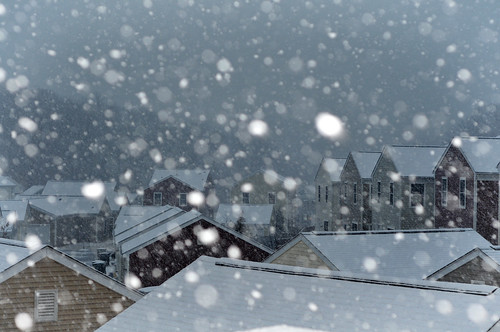
Understandably, winters in Chicago were long and hard. Still, I enjoyed them more than most of my friends and neighbors. I’ve always imagined that my Texas childhood created a snow deficit deep inside of me that no amount of Midwestern cold could fill up. As much as we all longed for spring come March, I was never sad, even then, to see snowflakes fall.
The hardest thing about winter for me was always the thaw. Those of you with experience living in frigid climates know what I’m talking about. The thaw is that period (maybe it comes once, maybe it comes and goes repeatedly, every winter is different) in which the sidewalks and streets are impassable. Snow has melted and refrozen until not even a polar bear could walk the ice safely. Or, layers of snow have turned to slush all the way through, and it’s impossible to move without icy meltwater pouring over the tops of my boots. Pushing a stroller through the muck and mess of a thaw? Absolutely impossible.
The hardest thing about winters in Chicago? Not being able to (safely) leave the house.
The hardest thing about summers in Florida? Not being able to (safely) leave the house.
Obviously, we’re no longer in danger of breaking our bones as we slip and slide on the sidewalks. But when my daughter asks at noon whether we can go for a bike ride, all I can think is “heat stroke.” It’s 95 degrees and very humid and I actually convince my kids to watch another half hour of tv rather than take them outside.
There are bright spots in both seasons. Here, swimming pools dot the landscape like weeds and as long as I’m willing to walk the gauntlet of sunscreen application (which always requires chasing the two-year-old around the house and listening to the seven-year-old whine that her face is white), we can enjoy being outside without too much pain.
In Chicago, the compensation came with sledding and snowman building. As long as I was willing to bundle up three children in snowsuits and long underwear, we could forget the discomfort of cold noses and tender fingers for an hour of fun.
In Chicago, I loved to sit directly on the warm radiator cover and watch snow fall past our third-story window. In Florida, I sit on the small sofa and watch that day’s thunderstorm pile up in the west. Seeing the palm fronds flatten in the wind and sensing the house go dark, I like to imagine that it’s cold outside. The reality feels more like getting hit in the face with solid swamp, but I keep the door shut and pretend. It’s very cozy.
More than cabin-fever and long hours spent indoors, these two seasons in these two places share a mood of longing. In Chicago, I yearned for warmth and color. In Florida, I want crisp air and sunshine that doesn’t burn like fire.
I’ve often felt guilty about giving in to this mood. As if desire is always an altogether bad thing, a temptation to ignore the good gifts right in front of us.
I think that is sometimes the case.
However, occasionally we only recognize the best things in life because we’ve longed for them and waited for them. Tulips in spring. The first day in fall when the humidity plunges.
The goal, I’ve decided, should not be some stay-in-the-moment mental trick we play on ourselves, but a more straightforward acceptance of goodness in the present and desire for something else. And why should these be mutually exclusive?
I love Florida’s daily summer thunderstorms. I love the wind, the dark clouds, and thunder rumbling all afternoon. But I am also eager for cooler temperatures and hours that can be spent outdoors. Summer, here, is about enjoying and longing.
And when the cooler days come, I’ll say goodbye to the thunderstorms with no regrets, knowing that I loved them in their time, but the thing I’ve really wanted, the thing I am now prepared to enjoy, has finally come.
Hope justifies longing.
“But hope that is seen is no hope at all. Who hopes for what he already has?” (Romans 8:24)

by Christie Purifoy | Jul 29, 2011 | Food, Religion

I stopped eating sugar three months ago. Well, to be perfectly honest, I still treat myself a bit on the weekends. And birthdays. I’ll never pass up birthday cake. But Monday through Friday, and even most of the time Saturday and Sunday, I sweeten my oatmeal with banana, I omit even the agave syrup from my smoothies, and I say no to every dessert, piece of candy, and slice of gum.
I’ve known for years that sugar wreaks havoc on my body. First, it was just my hormones. A direct link between dessert and my inability to get pregnant.
Highly motivated, I changed my diet. I had three miracle babies.
Then I went back to the cookies and ice cream.
I moved to Florida. I found a new doctor. He ordered a battery of tests. The news wasn’t good.
I don’t want to die of a heart attack or a stroke before I see my babies have babies. Once again, I am highly motivated.
I’ve had a fierce sweet tooth for as long as I can remember. If you had asked me when I was a child what my favorite food was, I promise you I would have said Cadbury Cream Eggs. Potato chips and popcorn, I can take or leave (though, of course, I take them frequently!). Chocolate chip cookies in the freezer will haunt me until every single one is gone.
When I first traded ice cream for mint tea after dinner, I felt sorry for myself. It seemed unfair. I imagined that everyone else could eat chocolate as often as they liked without fear of diabetes or heart disease.
My husband and children pour on the maple syrup while I frown and grumble over sprouted grain toast with none of my favorite blueberry jam.
But now . . . I’ve had an epiphany. I’ve realized something I might have noticed sooner if I hadn’t been preoccupied with feeling sorry for myself.
It was last Friday night. The week had been long, I was tired, and I decided to start the weekend off with a special treat. I would make chocolate chip cookies. And not just any chocolate chip cookies. The very best. The cookies from a cookbook called The Best Recipe. A cookbook that more than delivers on its title.
It was nearly nine o’clock when I sat down to taste those cookies, so sure that I was about to taste the goodness I’d denied myself all week.
After the first bite, I thought there was a mistake. I pictured my hand dumping in the cupful of brown sugar and wondered if I had miscounted.
My husband sat beside me at the table, and I asked, “Do these taste funny to you?” His look said, “What are you talking about?” and so I understood that the cookies only tasted strange to me. They were so, so sweet.
Unbearably sweet. I felt as if I were eating pure sugar, could almost feel the grains of it crunching sickeningly between my teeth.
This sweetness was no longer sweet. It was awful. One dimensional. Flavorless.
Here is the sweetness I’ve enjoyed all these months: the syrupy sweetness of a ripe peach, the crisp, tingly sweetness of ice-cold watermelon, the tart-sweet of blackberries, and the mellow, warm sweetness of a candy-colored sweet potato.
God has given me so many kinds of sweet: a whole spectrum of flavor and texture and color.
I never knew. Never truly tasted what was always right in front of me.
How often do we do this? Drag our feet and feel sorry for ourselves when all our father-God wants is to give us something good? Something better than the one-note flavor of whatever substitute we’ve provided for ourselves?
This thing I’ve been calling loss? Turns out, it was no loss at all.

