by Christie Purifoy | Oct 24, 2011 | Poetry, Seasons
For the past few days, I’ve been back in Chicago, remembering with my feet as I walk the familiar slate sidewalks.
If poems had mailing addresses, this one would surely be marked Chicago, the Southside.
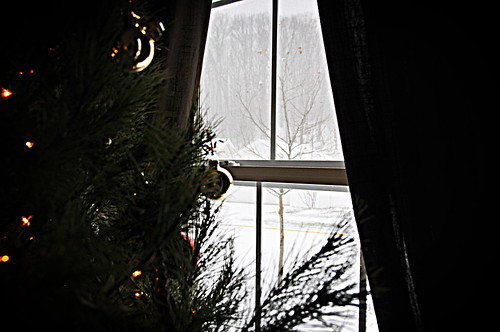
Winter hasn’t yet arrived, even in Chicago, but I’ve been reliving one particular winter memory. It was my first winter here, and the heavy skies were unburdening themselves of a record amount of snow. In early December, I sat at my writing desk trying to complete my first graduate seminar paper. Hunched close to my window, my Texas-bred eyes couldn’t stop wandering toward the snow-globe view.
Everything outside had been erased by the whiteness, even the people and the cars had disappeared. But then I saw a black parade slowly winding its way in front of my building. A hearse, a limousine, followed by a patient tail of black-flagged vehicles: I knew, without being told, that this was for Gwendolyn Brooks. Her death, on December 3, had been in all the papers and on every channel.
I can’t remember if the memorial was open to the public. I don’t think I would have made it to the university’s gothic chapel anyway, not through all that snow, not with a paper keeping me at my desk.
The chapel is beautiful, but it isn’t a poem. The slow slash of black in a washed-white world: that was a poem. I’m sure I could never fully capture what I saw in words, but there’s really no need. Gwendolyn Brooks had already done it.
Cynthia in the Snow
It SHUSHES
It hushes
The loudness in the road.
It flitter-twitters,
And laughs away from me.
It laughs a lovely whiteness,
And whitely whirls away,
To be
Some otherwhere
Still white as milk or shirts,
So beautiful it hurts.
– Gwendolyn Brooks
by Christie Purifoy | Oct 19, 2011 | Family, Grace, Vacation, Waiting
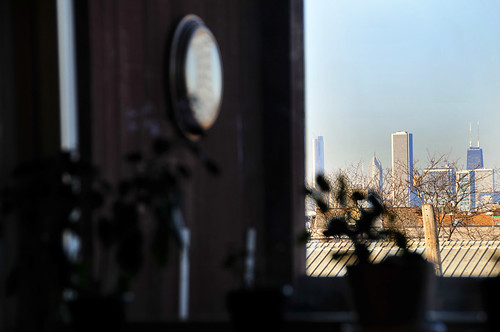
The firstborn and I will be back in Chicago soon. Four days with the people and places we both love best.
I feel an urge to write that we are going home, except that we aren’t.
It isn’t only that we sold our Chicago apartment 18 months ago. It isn’t because we have no family there. We do have many friends, and they were our family for ten good years. Rather, it is that I was once planted in Chicago. I’m not planted there any longer, though I haven’t yet laid down roots in any other place. I feel as if (actually, I hope as if) we are in between homes. (Florida, you are lovely, but I do not think you will ever be home.)
Perhaps I can write of Chicago from my daughter’s point of view. She was born there, after all, and has more of a claim to the place than I do. Here is the hospital where she took her first breath. A few blocks away is the converted hotel (with a tunnel where Al Capone once smuggled gin). It was her first home. Here is the museum that became her own private wonderland; fairy castle, baby chicks, and all. And there is pebble beach, our pebble beach, where we swam in summer and climbed ice dams in winter. Even now when I stand at some water’s edge and look to my left, I half expect to see the glittering wall of a downtown skyline. Perhaps she does, too.
In this life, home is always temporary. In Chicago, I learned that it is possible to feel at home in a temporary place. It is possible to breathe deeply and live thoroughly in a home that won’t always be home.
Possible, yes, but never a given. Or, perhaps I should say that it is exactly that: a given thing. A grace thing.
When God tells his exiled people in Jeremiah that he will bring them home one day, he also says: “Build houses and settle down; plant gardens and eat what they produce. Marry and have sons and daughters; find wives for your sons and give your daughters in marriage …” (Jeremiah 29:5-6). His gift to them is a home in exile. Permission to live, even as they wait.
“For the Lord your God is bringing you into a good land – a land with streams and pools of water, with springs flowing in the valleys and hills.”
(Deuteronomy 8:7)
by Christie Purifoy | Oct 17, 2011 | Art, Books, Poetry
In my ideal Christian bookstore, the Jesus knick-knacks and the Amish romances would be pushed to a far corner. The coveted window display space would be filled with books like the collected poems of Czeslaw Milosz.
I guess if I’m being perfectly honest, my ideal Christian bookstore would look exactly like my favorite independent bookstore in Chicago’s Hyde Park neighborhood, with a few more Bibles. As Madeleine L’Engle writes in Walking On Water, “Christian art? Art is art; painting is painting; music is music; a story is a story. If it’s bad art, it’s bad religion, no matter how pious the subject.”
Even if you think that L’Engle pushes the point too far, I imagine that many of you, having picked up a copy of Milosz’s New and Collected Poems (1931-2001), would agree that this is a writer Christians should be reading. A believer and a Nobel Prize winner, Milosz never turned his face away from the darkness of twentieth-century history. Yet he did this without losing his grip on hope and belief. A light shining in darkness. I think that may be my definition of Christian art.
Rays of Dazzling Light
Light off metal shaken,
Lucid dew of heaven,
Bless each and every one
To whom the earth is given.
Its essence was always hidden
Behind a distant curtain.
We chased it all our lives
Bidden and unbidden.
Knowing the hunt would end,
That then what had been rent
Would be at last made whole:
Poor body and the soul.
– Czeslaw Milosz
by Christie Purifoy | Oct 13, 2011 | Art, Books, Family, Stories, Writing

With three talkative children at the table, the ship of dinner-time conversation is rarely steered by the adults in our house. Which is surprising given that the youngest is working with a somewhat limited vocabulary. To make up for this handicap, he frequently resorts to loudly repeating a single word with varying intonations. His vocabularly may be small, but he certainly knows what talkative is supposed to sound like.
Recently, I yanked my mind from some daydream or other and recognized that the children were discussing Harry Potter. This, too, is strange, given that not one has finished reading a single book of the series, nor have they seen the films. I recognize, with a bit of sadness, that Harry Potter has joined the company of imaginative figures, untethered from any particular medium, which populate a child’s imagination. Harry Potter, Winnie the Pooh, a Jedi Knight … they’re all hanging out together in my five-year-old’s dreams.
As if trying to get a firmer grasp on all that she doesn’t yet know, the firstborn says, “But Harry Potter isn’t …”, and I gasp. I am suddenly sure that she’s about to say “true.” She doesn’t. Finishing her sentence over my raised eyebrows, she says, “Harry Potter isn’t real, is it Daddy?” He says easily, “No honey, it isn’t real.” And I sigh, grateful I don’t have to intervene.
But if she had said true? That would have been a very different story.
It isn’t simply that I love Harry Potter. I do. Much as I loved Narnia when I was my daughter’s age. But it isn’t love (or delusion, for that matter) that would have caused me such pain to hear my child say, “That story isn’t true.”
Despite what you may now be thinking, I don’t believe there are broom-flying wizards right around the corner. That’s our reality. No broom-flying wizards. I might wish it otherwise, but I accept this.
But true? Not true? To me, at least, those words suggest something very different from what we usually mean when we say “true-life.” No, Harry Potter’s world is not “true-life.” But true? Yes!
Ours is a fallen, not-quite-what-it-was-meant-to-be world, and our reality isn’t always true. At times, it lies. It says this world tends towards chaos, you are on your own, watch out for number one, pursuing goodness is a waste of time.
Stories – at least the excellent ones – give us a glimpse of the world as it was always meant to be. Through the lens of a story, we can see the world as it will be again one day.
Reality? Too often it is a cracked lookingglass. Stories? No matter how fantastical, this is often where we spy the truth.
When Jesus came walking in bare feet to rescue us, he was asked many questions. More often than not, he answered them with stories.
He told us himself that his name was Truth, and he told us stories.
by Christie Purifoy | Oct 11, 2011 | Family, God's promises, motherhood, Waiting

If there is one word to describe most parents of young children, it is this: tired.
However, the tiredness itself doesn’t always make sense. It isn’t always logical. For instance, there is this strange equation: I am less tired, less overwhelmed now with three children than I was with one (and my youngest has yet to learn to sleep all night in his own bed).
I’ve come to believe that many of the most difficult periods of parenting are like bad weather. The radar map of my early years as a mother was covered in angry reds and oranges. More recently, the forecasts have called for blue skies, occasional rain.
Is there some parenting secret to be tapped here? Have my years of experience brought me wisdom and thus fair weather?
I don’t think so. If anything I have abandoned my early intensity to always do the right thing. I have forgotten much of my new-mother knowledge.
Absorbed in the busyness of living, I can no longer recall the good advice of the parenting books I used to read. When the two-year-old refuses his bedtime and asks for popcorn instead, I sometimes remember how firm and controlling we once would have been. Now, more often than not, our evening couples time is spent in the company of a toddler. We talk over his head and share our popcorn. Maybe it isn’t ideal, but it isn’t terrible, either. He’s very cute eating his popcorn, this one is.
And yet, the “secret” if there is one doesn’t lie in a relaxation of standards or parental laziness. The weather is fair, but I’m convinced that we can take little credit for this.
The little girl who was overwhelmed by life (and so overwhelmed her mother) has shifted into the child who starts her homework as soon as she walk in the door after school, the child who makes her bed every day because she likes her room to look nice. Knowing firsthand how emotions spiral out of control, she says to me, “The girls will probably fight to sit next to Emma at the birthday party. But, I’ll be okay sitting next to someone else.”
How did this happen? And why did I assume that the weather would always be rough? Why did I listen to the well-meaning older parents who said, “Oh, just wait! If you think it’s hard now …”
Jesus has said, “Don’t worry about tomorrow. Tomorrow will worry about itself.” And, yes, I find that each day does have its own trouble. But far worse than the particular trouble of each day is our despair when we believe that all we can hope for are storms. The storm is one thing, but the hopelessness that says, “morning will never come” is much more destructive.
Morning will dawn, and the one who is beaten down by life’s storms will open the door and find sunshine. Perhaps that day is coming sooner than you think?
